Understanding Line Movement and Steam
The Illusion of Randomness
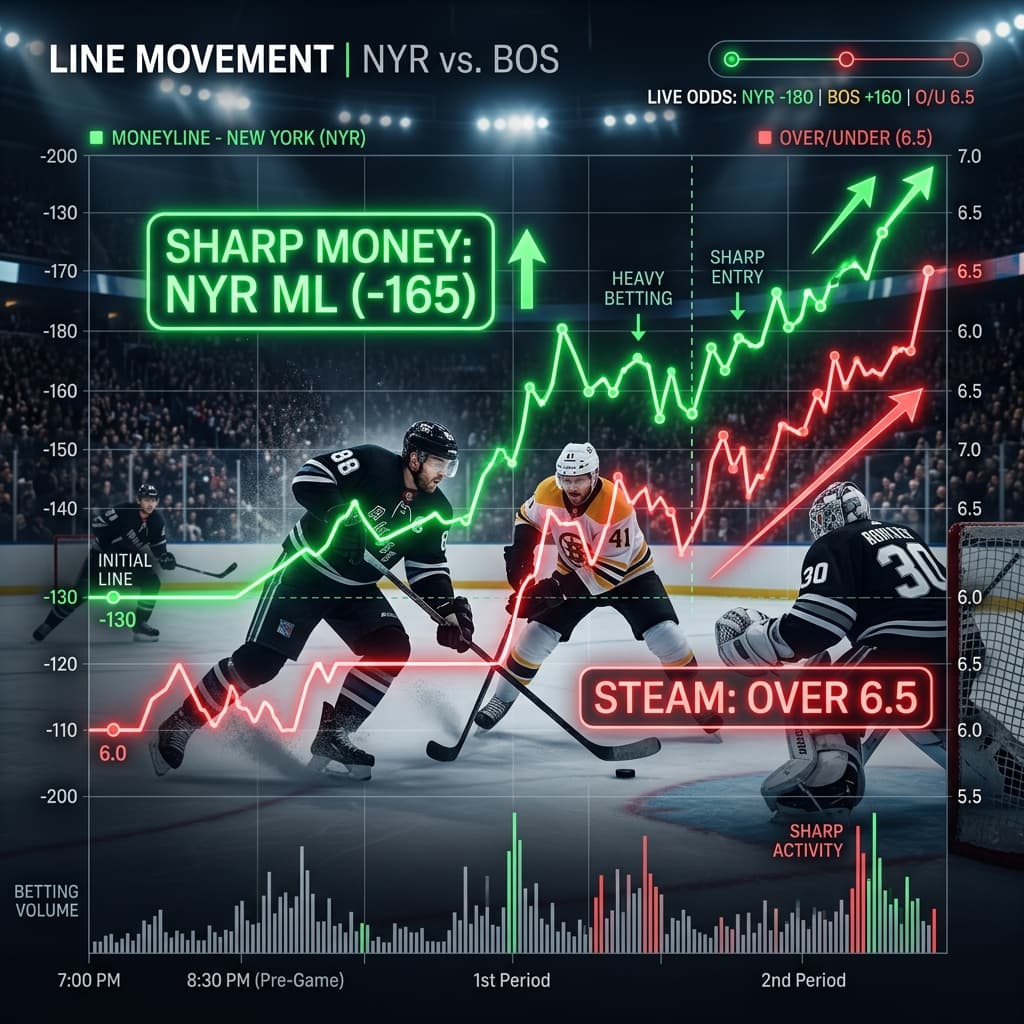
Have you ever watched a market line jump an entire point with absolutely no breaking news or injury reports? It feels random, but in the sports market, nothing happens by accident. market maker odds are not static predictions of the future; they are highly fluid financial instruments designed to balance liability. When lines move rapidly across the entire market, it is because significant capital is forcing them to move.
Understanding why lines move and who is moving them is the cornerstone of any successful sports data analytics platform.
What is Steam?
Steam refers to a sudden, uniform line movement across multiple market makers caused by massive, coordinated action.
Imagine a highly respected quantitative syndicate identifies a mathematical error in the opening line for an NBA game. They don't just take a $50 position; they deploy hundreds of thousands of dollars across the global market simultaneously. When market makers detect this sudden influx of "sharp" money, their risk management algorithms instantly adjust the line to limit further exposure. This triggers a domino effect across the industry.
Tracking steam allows you to peek behind the curtain and see exactly where the smartest money in the room is flowing. However, manually tracking steam across dozens of books is impossible for a human. This is why model-vs-market sports analytics software is essential for modern market participants.
The Holy Grail: Reverse Line Movement
While steam is important, the holy grail of market tracking is Reverse Line Movement (RLM).
RLM occurs when a line moves in the opposite direction of the public's positions. Imagine this scenario: 85% of the public is investing in the heavily-favored Dallas Cowboys at -7, but the line suddenly drops to -6.
Why would a market maker intentionally give the public a better number? Shouldn't they raise the line to -8 to discourage more Cowboys positions?
The answer lies in the volume of the capital. While 85% of the public-side wagers are on the Cowboys, the 15% on the opponent represent significantly more total money—and that money belongs to respected, high-limit sharp analysts. The market maker respects the sharp capital more than the public capital.
When a publication contains comparable opening and later prices, EdgeSlate can show the observed movement as research context. A price move alone does not identify who caused it, prove “sharp” activity, or establish an edge.

EdgeSlate Research
Quantitative Analytics Team